

Did you know?

In France, almost 3% of all animal uses for scientific purposes are dedicated to species conservation and environmental protection. In 2024, this represented 346,824 uses of animals for these purposes.
Could you tell us about your career and your commitment to wildlife?
Since 2015, I have been responsible for the animal facility and the team monitoring both housed and non-housed wildlife at the Department of Ecology, Physiology and Ethology of the Hubert Curien Multidisciplinary Institute (DEPE-IPHC) in Strasbourg. In addition to my role as the delegate for the User Establishment (UE), I am also the leader of the Animal Welfare Unit. In 2023, I was appointed as an expert member of the CNRS Wildlife Unit (CFS), whose remit is to support User Establishments working with wildlife in experimental settings, particularly with regard to regulatory aspects, networking amongst stakeholders and the development of specialised training programmes. Since 2025, I have also been a member of the University of Strasbourg’s Strategy Committee for Animal Research and Alternative Methods (CStRA).
I began my scientific career in 1993 with a Postgraduate Diploma (D.E.A.) in Eco-ethology, obtained, focusing on the welfare of captive animals. This was followed in 1997 by a PhD in Life Sciences on the genetic management of captive and wild lemur populations. Following the establishment of a molecular ecology laboratory at the Strasbourg Primate Centre, I joined the CNRS in 2001.
Why study wildlife?
Rapid changes to ecosystems are being caused by climate change, habitat fragmentation, invasive alien species, emerging diseases and human activities. Understanding these mechanisms therefore requires the study of living animals in their natural environment. Furthermore, the ‘One Health’ concept – a holistic approach that recognises that human health is closely linked to that of ecosystems – encourages research into wildlife.
The IPHC’s research teams study the adaptive strategies of animal species in the face of natural or human-induced environmental pressures. On the one hand, they assess species’ ability to survive in a rapidly changing world; on the other, they establish a scientific basis to support decision-making: conservation plans, land-use plans, management measures, etc.
The use of wild animals for research is subject to specific authorisations (such as capture authorisations or ringing permits, Directive 2010/63/EU) and must – like any use of animals for scientific purposes – incorporate the 3Rs principle: Replace, Reduce, Refine.
From the Southern Territories to Alsace: how can the 3Rs be applied in practice to the study of wildlife?
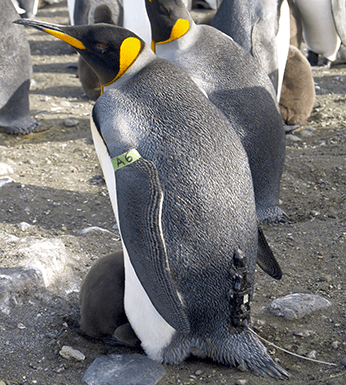
The king penguin (Aptenodytes patagonicus) is a colonial seabird that has adapted to withstand changes – predominantly human-induced – in its environment. In the polar regions, climate change and the limited number of areas suitable for breeding exacerbate the stress to which these seabirds are subjected. Current studies focus in particular on thermal stress during heatwaves and its impact on the health, growth and reproduction of king penguins.
Over the past 10 years, the Ministry has granted eight Project Authorisation Applications (DAPs) for this model within our Department of Ecology, Physiology and Ethology. Several measures have been implemented to optimise the 3Rs for the king penguin, including:
-
Replacing surgical cardiac implants with a non-invasive device, consisting of two thin electrodes placed in a skin fold;
-
The use of a 3D-printed dummy egg, kept at incubation temperature, to reassure birds during handling and prevent eggs from breaking.
-
The systematic use of hoods to reduce stress during restraint and handling.
-
The elimination of weighing birds that are brooding an egg or rearing a chick, in order to minimise risks to reproduction.
-
Limiting blood sampling to a single sample at the start of restraint to reduce the duration of handling.
-
Using the same sample for multiple studies, where possible, to limit the number of birds handled.
Another example is the European hamster (Cricetus cricetus), wich is at risk of extinction across its entire range, from eastern France to Russia.
As part of a national action plan, the DEPE is carrying out research to analyse the causes of this decline and assess the factors that could improve reproduction and survival of the species in its natural, dependent habitat, which is strictly confined to agricultural plains. A comprehensive study of the European hamster is require for these projects, as no other model can serve as a substitute.
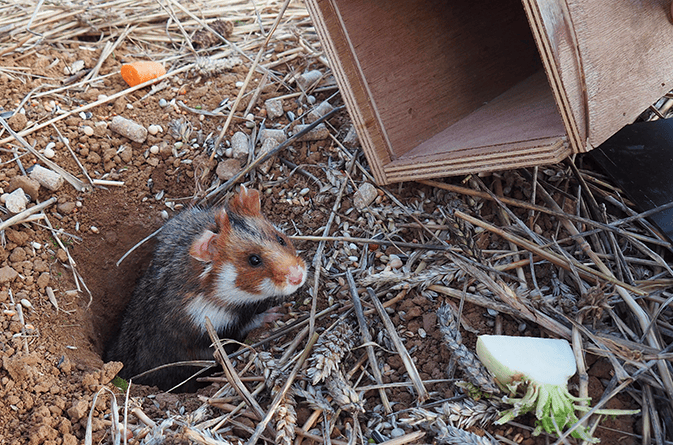
Since 2015, the DEPE has submitted 11 DAPs based on the European hamster model. Laboratory experiments focus on the adaptive mechanisms of these animals in response to anthropogenic pressures, particularly the plasticity of hibernation and its impact on annual reproduction. Studies conducted in enclosures under semi-free-range conditions enable the impact of different crop combinations on reproduction to be analysed. Finally, the reinforcement of wild populations is ensured through several annual releases into the wild. The 3Rs are applied at every stage of these studies:
-
For handling and surgical procedures, a 3D-printed anaesthetic mask, tailored to the animals’ morphology, improves the effectiveness of sedation and minimises gas leakage. A transparent transfer box also allows for visual monitoring with minimal stress.
-
In semi-freedom, a restraint sock that makes use of their natural burrowing behaviour helps to reduce handling time and avoid the need for anaesthesia for certain procedures.
-
In captivity, hamsters are housed individually in an environment that replicates their natural conditions as closely as possible (shelters, materials for burrowing and gnawing) and are fed a diet that mirrors their natural diet.
-
Releases into the wild are carried out under conditions that facilitate the animals’ acclimatisation, notably through prior dietary preparation and support at the time of reintroduction.
What are the limitations and prospects of the 3Rs in wildlife research?
Using wildlife in experiments helps to answer major scientific questions while adhering to the 3Rs: preserving ecosystems, respecting biological characteristics, maintaining population balance, and observing life cycles.
In the face of climate change, invasive species and emerging diseases, using drones, modelling and artificial intelligence to study these populations is creating more opportunities to minimise interventions that could introduce biases and distort results and conclusions.