



A major challenge: harnessing the vast scientific literature through machine learning
The landscape of biomedical literature research is undergoing a major transformation. Thanks to tools such as BimmoH (Biomedical Models Hub), funded by the European Parliament and developed by the European Commission’s Joint Research Centre (JRC), scientists now have access to a centralised platform to explore models based on human biology. This initiative forms part of a broader drive to reduce reliance on animal models whilst improving the relevance of results for biomedical research.
With nearly 39 million references indexed in PubMed, the leading database in the life sciences, researchers face considerable difficulty in identifying the most pertinent publications on these models and in addressing their specific scientific questions. The BimmoH project has risen to this challenge by combining automated classification using Artificial Intelligence (AI) and supervised machine learning. A complex search query was first employed to test several algorithms and reduce the corpus to 4.3 million articles, before an AI system was trained on 30,000 documents comprising identified models, negative data, and experts-validated queries.
In total, 12 combinations were evaluated, with ambitious targets: 95% specificity, 85% precision and 50% sensitivity. The results exceeded expectations: the system identifies 800,000 relevant articles with 85–90% precision, covering 40–50% of pertinent publications. The database is updated on a quarterly basis.
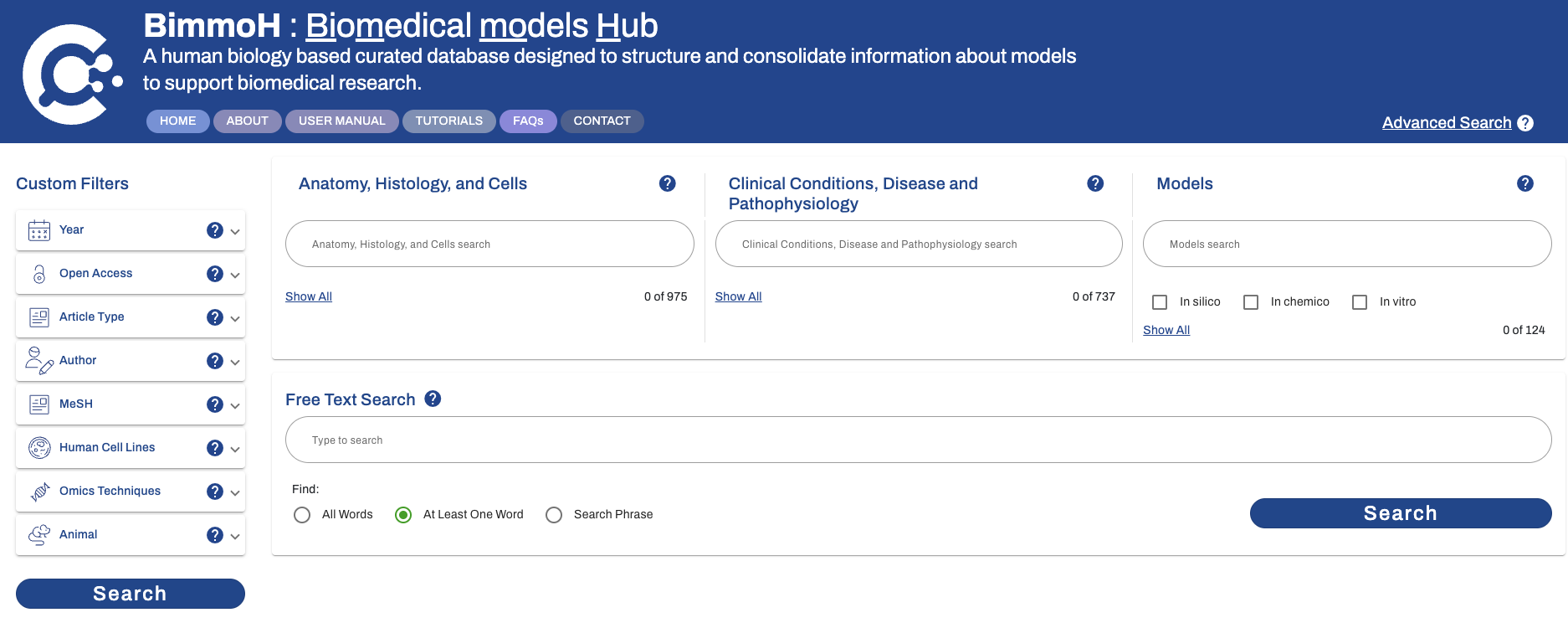
https://bimmoh.eu/
Intelligent data structuring
BimmoH organises and classifies data according to specialised vocabularies, including:
-
Human anatomy and pathologies
-
In vitro and in silico models
-
Cell lines (2,005 catalogued)
-
Omics techniques
The 3Rs: a strengthened ethical framework
BimmoH adheres to the 3Rs principles (Replace, Reduce, Refine):
-
Replace: through the use of human-derived models based on human cells, such as organoids, organs-on-chip (OoC), and cell lines, or computational modelling informed by human data, in place of animal models.
-
Refinement: by limiting the number of experiments required through targeted selection.
A strategic tool for all stakeholders, with online training
BimmoH is designed for a diverse audience:
-
Researchers: the platform provides rapid access to structured data to guide their work, enabling researchers to save time and focus on approaches with greater human relevance.
-
Industry: the platform facilitates the identification of innovative models for the development of new therapeutics, including medicines and biologics.
-
Regulatory agencies: to evaluate the efficacy and safety of novel therapies.
-
Animal experimentation ethics committees: to check whether alternatives to animal models exist for a given issue and thereby better assess the feasibility of replacing animal use.
Tutorials and a user manual are available to help users gain a thorough understanding of BimmoH's features and functionalities.
In the era of personalised medicine and New Approaches Methodologies (NAMs), tools such as BiommoH are essential for reconciling innovation, efficacy and ethics responsibility. Their widespread adoption has the potential to redefine the standards of biomedical research in the years to come.