

Opal Short Notes Challenge

Opal is collaborating with the FC3R to promote scientific quality and transparency by supporting the ‘Short Notes’ initiative through a dedicated prize: the Short Notes challenge!
Publishing all results: an ethical and scientific challenge
In its recommendation No. 2026-48, entitled Use of animals for scientific purposes: ethical issues and recommendations, the CNRS COMETS makes an explicit recommendation:
“All results of research involving animals should be published on the ‘Short Notes’ platform set up by the FC3R, including when they are negative or deemed inconclusive, so that similar experiments are not repeated unnecessarily, particularly when they are doomed to failure.”
This recommendation highlights a major ethical issue in the field of animal experimentation: the failure to disseminate results already obtained is not only a loss of scientific information, but can also lead to the repetition of experiments that could have been avoided. The publication of negative, inconclusive or confirmatory results thus becomes a concrete lever for scientific integrity, research ethics and the implementation of the 3Rs — Replace, Reduce, Refine.
Beyond the field of animal experimentation alone, this opinion highlights a more general question: what becomes of all the results produced by research when they do not find a place in traditional editorial formats?
A blind spot in the scientific publishing system
In traditional publication models, scientific articles are most often structured around a hypothesis, the elucidation of a mechanism, a proof of concept, or a breakthrough deemed sufficiently novel. This narrative framework, essential to part of the scientific literature, nevertheless leaves out many methodologically sound results: unsuccessful trials, negative or inconclusive results, confirmatory observations, methodological adjustments, exploratory data, or results too narrow in scope to constitute a full article.
These results are by no means secondary, however. They can enable other teams to avoid avenues that have already been explored, to compare their own data, to improve a protocol, to confirm, refute or qualify published results, or even to better plan new experiments. When they remain unseen, they contribute to what Rosenthal described as early as 1979 as the ‘file drawer effect’: the tendency to publish predominantly results deemed positive, original or attractive to the scientific community and publishers, whilst leaving a large proportion of the results produced in the filing cabinets (Rosenthal, 1979)
This effect contributes to publication bias and undermines the reproducibility of scientific knowledge. It also represents a loss of collective and financial efficiency, particularly when results already obtained could have avoided the repetition of experiments, whether or not they involve animals.
Short Notes: a complementary editorial space
The editorial line of the GIS FC3R’s Short Notes platform has been designed to address this blind spot. It is not presented as an additional scientific journal with a thematic editorial line, nor as a competitor to scientific articles or preprints. It occupies a complementary space that is well-known but neglected: results that have not been included in a traditional publication. Short Notes enable the sharing of targeted, methodologically sound results—as they are peer-reviewed—which are citable and permanently accessible.
Short Notes allow for the publication of positive, negative, inconclusive, confirmatory, methodological or exploratory results, whether or not they involve the use of animals or animal-derived products. Their aim is not to produce an extensive scientific narrative, but to make clearly documented experimental facts available: why the experiment was conducted, how it was carried out, what results were obtained, and under what conditions they can be interpreted.
This approach is based on a simple requirement: not to judge the value of a result solely on the basis of its novelty or expected impact, but also on the basis of its methodological quality, transparency and potential usefulness to the scientific community.
A short, peer-reviewed and enduring format
Short Notes are published in English, to consolidate knowledge on an international scale, in a deliberately short format of around 2,000 words, accompanied by two pages of captioned figures. The Materials and Methods sections, metadata, and appendices may be expanded in detail to allow for a precise understanding of the experimental conditions and, where relevant, the comparison or replication of the work.
Each manuscript is assessed by at least two experts according to several criteria: clarity of the text, robustness of the experimental design, rigour of data analysis, quality of the figures, and transparency of the experimental report. The assessment process does not aim to request new experiments but rather to ensure that the results presented are comprehensible, correctly contextualised, and sufficiently documented to be useful to a broad scientific audience.
Approved Short Notes are deposited in the national open archive HAL and assigned a DOI (Digital Object Identifier). This dual anchoring guarantees their long-term accessibility, traceability, citability and indexing by search engines and bibliographic tools. The model adopted is Diamond Open Access: Short Notes are free for both authors and readers.
Encouraging initial indicators
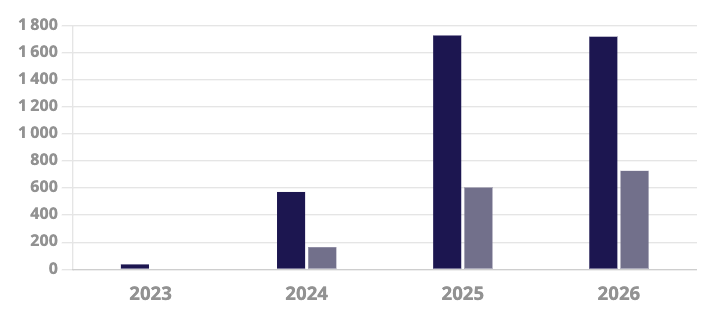
Following an initial set-up phase, the Short Notes platform is now reaching an important milestone. Initial usage data from HAL shows that there is a readership for these results, which are usually not very visible.
The first seven Short Notes published since 2024 have now been viewed over 4,520 times and downloaded 1,494 times on HAL (as of 15 May 2026). Around half of the readership is international, with a significant proportion of downloads (25%) coming from the United States.
These figures remain modest compared to the publication volumes of traditional scientific journals, but they are particularly significant for results which, without this format, would probably have remained absent from the formal literature. They show that this content is not merely accessible: it is viewed, downloaded and potentially used by the entire scientific community, which is an excellent way of promoting results that were previously inaccessible.
An analysis of the ratios between views and downloads provides further insight. According to the Short Notes, between 26% and 44% of visitors actually download the full document from during their visit. This level suggests that a significant proportion of readers do not limit themselves to viewing the descriptive page, but access the full scientific content.
These findings indicate that the determining factor is not merely the length of time spent online, but rather the nature of the content offered and its scientific value. Short Notes are therefore not merely visible: they appear to meet a genuine need.
A growing momentum
The dynamics of submission and evaluation also confirm the gradual establishment of the format. To date, 10 manuscripts have been submitted, including one international submission. Seven Short Notes have been accepted, one has been rejected and two manuscripts are currently under review.
The challenge is to establish a high-quality editorial format on a lasting basis, capable of accommodating results often overlooked by traditional channels whilst maintaining high standards of evaluation, readability and transparency, so that readers have a source of reliable and validated results
Short Notes thus help to broaden the scope of what can be published and promoted in the scientific literature: not only spectacular, but also robust observations, confirmations, limitations, documented failures and useful methodological findings.
Alignment with developments in scientific evaluation
This positioning is part of a broader evolution in the scientific landscape. Open science policies, the recommendations set out in the San Francisco Declaration on Research Assessment (DORA) and the questioning of strictly bibliometric approaches call for a move away from reducing the value of scientific work to the editorial prestige of the journal in which it is published.
In this context, Short Notes contribute to a deliberate diversification of scientific output formats. They help to better recognise contributions that often remain overlooked, particularly experimental, methodological and technical contributions. They also provide a suitable framework for results arising from the day-to-day work of research teams, platforms, engineers, technicians and researchers.
This gradual recognition of diverse publication formats is essential for building a science that is more transparent, more robust and more faithful to the reality of scientific output. The main French research organisations (Inserm, CNRS, INRAE, CEA) have begun to change their evaluation practices and are actively promoting the recognition of Short Notes as scientific output in their own right, thereby encouraging research staff to share all their results.
Towards international recognition
In order to gain sustainability, Short Notes will need to increase both audience and international recognition. Significantly, Short Notes are cited as contributions to the Open Science effort, to the sharing of results and to transparency, notably by the ‘ Open Science Toolbox for Animal Research” developed by the German Bf3R and in a recent opinion piece on the usefulness of pre-registration (Heinl C et al. 2026).
Finally, the European ERA NAMs initiative (European Research Area on Accelerating New Approaches and Methodologies (NAMs) to advance biomedical research and the testing of medicinal products and medical devices) explicitly highlights the importance of sharing protocols and negative results within its working group dedicated to transparency and raising awareness of NAMs, thereby paving the way for the widespread adoption of Short Notes by European countries.
In conclusion, in light of the COMETS recommendation, Short Notes thus appear to be a practical tool in the service of a more comprehensive, responsible and open science that takes into account all research results. Making these results visible does not mean lowering standards; it means recognising that scientific robustness is also built through the transparent provision of what confirms, qualifies, limits or contradicts established knowledge.